
Jesus tragic figure?

Two quotes from John Gray’s March 13 review in the New Stateman of new books by Peter Watson—The age of nothing— and Terry Eagleton—Culture and the death of god:

If Yeshua (the Jewish prophet later known as Jesus) had died on the cross and stayed dead, that would have been a tragedy. In the Christian story, however, he was resurrected and came back into the world. Possibly this is why Dante’s great poem wasn’t called The Divine Tragedy. In the sense in which it was understood by the ancients, tragedy implies necessity and unalterable finality. According to Christianity, on the other hand, there is nothing that cannot be redeemed by divine grace and even death can be annulled.

Complete misreading of Christianity, to think of the resurrection as a trick, a deus ex machina of the kind featured at the end of some classical plays. One doesn’t need to believe in the resurrection and the messianic interpretation to see that Gray here is assuming a very old posture that was of course rejected by the gospels themselves. But to think Jesus’ death is not seen as a tragedy in Christianity: No need to know what tragos and victimization mean to consider that what is splashed everywhere from churches to house walls, not to mention paintings and scuptures, for centuries now, and perhaps coming to an end (but I wouldn’t bet on it) is the belief that Jesus is forever both on the cross and resurrected. The real problem Greeks had with the passion—many would have agreed with John Gray—cannot be evacuated so easily. As for redemption of everything by divine grace: Christianity struggled mightily with this notion. Surely there are things that are unforgiveable? And yet, no matter the terrible failures of Christianity (-ies), the invisible and sotto voce call for boundless forgiveness, that is what keeps sounding. As for Gray calling Jesus Yeshua, that is fake historicization, part of his unthinking attempt to evacuate the problem. By problem I mean a tragic vision of life that incomprehensibly hearkens to forgiveness and a transformation of life mechanics into another, barely imaginable life, here and now. And here is another quote showing Gray’s willful misunderstanding:

The anti-tragic character of Christianity poses something of a problem for Eagleton. As he understands it, the Christian message calls for the radical dissolution of established forms of life – a revolutionary demand, but also a tragic one, as the kingdom of God and that of man will always be at odds. The trouble is that the historical Jesus seems not to have believed anything like this. His disdain for order in society rested on his conviction that the world was about to come to an end, not metaphorically, as Augustine would later suggest, but literally. In contrast, revolutionaries must act in the basic belief that history will continue, and when they manage to seize power they display an intense interest in maintaining order. Those who make revolutions have little interest in being figures in a tragic spectacle. Perhaps Eagleton should read a little more Lenin.

… And John Gray the gospels. What this author calls Jesus’ disdain for order in society was a refusal of the disorder and anarchy parading as order.
dates of birth

The need to know the dates of birth of my parents made me discover the digitized archives of the Côtes d’Armor, a département in Brittany—one of 96 in France. I could not find my parents’ dates in these digitized archives because they cover the years from 1467 (the date of the earliest registry of births in the collection, in Latin at the time) to 1902, sometimes 1906. My parents were born in 1906 and 1913 and the record of their births probably has not been digitized. It is still in the mairies‘ registries of their villages of origin.

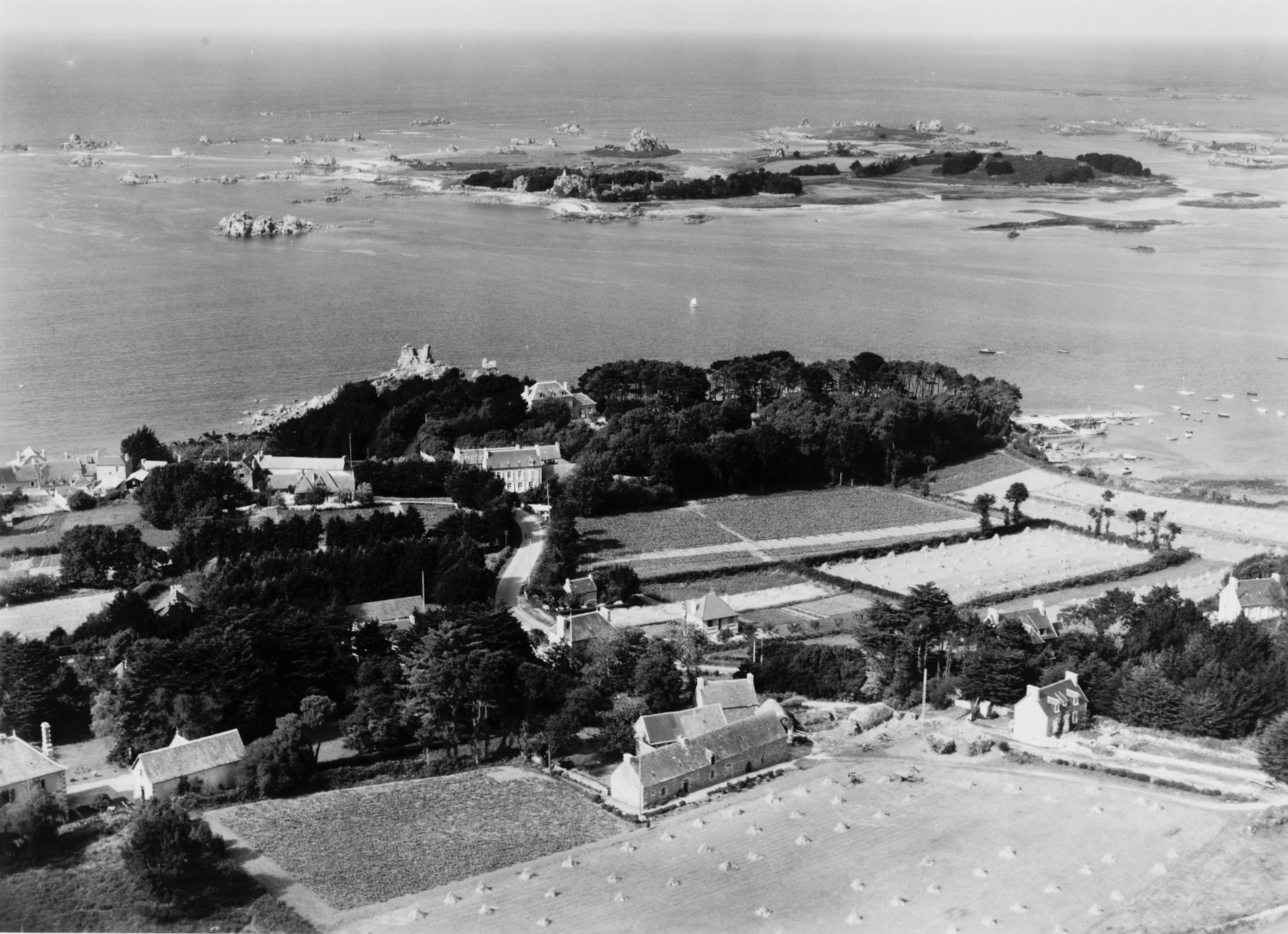
Why don’t I know their dates? The main reason is that when we were growing up in the fifties in traditional Catholic villages in Brittany (and I suppose this is true of the rest of the traditional Catholic world at the time) we didn’t celebrate birthdays, or at least not our parents’. Saints’ days were celebrated or kept in mind and advertized by collective celebrations (pardons), the imagined days of a glorious entrance or birth into heaven after the travails of life. Like that of Saint Gildas, a sixth-century Welsh saint whose traces are celebrated from northern to southern Brittany, such as at this island below, called l’île Saint Gildas in French. The photograph taken from heaven comes from the Henrard collection and was bought by the Archives départementales where I found it. Photo taken in the late fifties (dates given: 1948–72)?

Enezenn Sant Gweltaz (St Gildas)

Boycott and boycott

Two boycotts are presently targeting Israel. One takes aim at companies and organizations having their operations, or some of them, in the settlements and implantations that have been developing on the West Bank since the seventies. The second boycott, started by the BDS movement (= Boycott, Divestment, Sanctions), made news recently because of the American Studies Association’s announcement of its support of a boycott of Israeli academic institutions.

Supporters of the anti-Palestinian policies of Israel’s present government are trying hard to confuse the public regarding the first one, the limited boycott of companies operating in the settlements on the West Bank, because it has a sound legal and ethical basis. It can really hurt and accelerate peace negotiations. They use boycott number 2, the BDS one, which they know is problematic for most people in the US, as if it were the basis for boycott number 1, the limited one. See for instance yesterday’s NYT article on countering boycotts by Landler, or today’s opinion piece by the foreign editor of Die Welt.

A few words about boycott one, which targets companies and products in the settlements. I support this boycott because these settlements are illegal and “an obstacle to peace” (footnote: this was the diplomatic language used by US Secretary of States until it was dropped by Reagan’s administration. Obama’s went tentatively back to it, at the beginning of his administration). The implantations prevent a negotiation and resolution of the Israel-Palestine conflict on the basis of UN Resolution 242 and the Oslo Accords of 1993–95. A solution to the conflict on that basis, with land swaps, is possible. But the settlements’ continuous expansion since the Oslo Accords and especially now, in the face of efforts by the Obama administration to put the peace process back on rails, makes an economic and cultural boycott of these settlements necessary. We’ll see how a recently weakened AIPAC frames the discussion in the days to come. Kerry is to address it on Monday, if the situation in Ukraine, Crimea, and Russia, not to mention Syria, does not need his attention.

The second or BDS boycott is legally and ethically confusing to most people. The three main elements of its platform are: 1) equal rights of citizenship for current inhabitants; 2) the end to the occupation; 3) the rights of unlawfully displaced persons to return to their lands and gain restitution for their losses. Because numbers 2 and 3 could apply to the state of Israel as a home and refuge for many Jews since 1948, I don’t see how it can be supported.

Boycott number one needs to expand if Israel’s government continues to refuse to engage in the peace process.