
Facebook metamorphosed and metastasized yesterday into a new entity called meta or metaverse. The use of meta, if taken to mean beyond, behind, points to the company’s holy grail of being a universal messianic presence to everyone. What will this second baptism change in a company that is so focused on mediating every move of its desiring subjects? Its pocket machinery increases our potential distance and separation from other living beings. It is known that it would like to go further and build the next level of imaging machines without having to go through Apple’s iphones or Google’s phones and search engines. Capitalist institutions rely upon this fleeing and deepening distance, separation, and absence, including that from oneself, to offer their paying (re)mediations of a false presence. Our industry, commerce, and banking need our estrangement from each other. So, Facebook or Meta are perfect, wildly successful expressions of this much larger movement. They are not so very different from the kingdoms of ancient times where, sometimes with the help of priests, kings justified their existence and increasing authority by providing and managing close access to divine-like representations in temples and imagery that were devoted to ever-distant gods. Like them, Facebook and other companies help increase our distance from each other while circulating and putting right into our pockets simulacra of intimate presence.
All posts by Gildas Hamel
library
The UCSC campus has officially been invited to become a member of the Association of Research Libraries (ARL). It will be #126 in this select group. I love the architecture of both UCSC libraries, the McHenry main library and the Science and Engineering Library. I greatly appreciate the services and the promptitude of very busy librarians, especially in the acquisition system. I like the tools, for instance the speed of searches, even though I am not too fond of certain aspects of it, for instance the tendency to gush unhelpful information instead of the sought out title and an intelligent form of the Dewey shelf browsing. And I’m glad that UCSC leads the good fight in shaping the Open Access Initiative of the future.
But I find it difficult to celebrate this recognition for the following reason. It is astonishing that the ARL didn’t seem aware that a fraught decision to remove and shred about 83000 titles—some of them irreplaceable—was taken in 2014 and executed in the summer of 2016 with no consultation of faculty, in order to create more space. See T. Wipke’s Emeriti’s Editor’s Corner for some of the numbers involved. Or see my two blogs, Pulp Fiction and Bits of Knowledge, regarding this sad affair.
Morale et religion
I read Bergson’s Les deux sources de la morale et de la religion, Essai sur les données immédiates de la conscience or his booklet on laughter when I was in the seminary. I don’t have the time, inclination, or capacity to go presently into Bergsonian philosophy. All I can say is that I see his dynamics of closeness and openness as both necessary, if only in following our nineteen-month grandson who is beginning to feel his way between the rules necessary for life, which he can only receive without rational discussion, and the constant, necessary exploration that will translate later as a permanent struggle between desire and delayed gratification. But what I don’t see evoked in Blake Smith’s reflection in the Tablet on Bergson or in Bergson himself—except in his idea of the prophet—is the necessity for modern capitalist society, i.e. all of us, to use and abuse the traditional, conservative moral systems that are vehiculated by millions of villagers going to work in new cities. They bring to their work and new urban environments their traditional values of fidelity, courage, honesty, sense of duty, reciprocity, cooperation, etc. These values in turn are systematically used and abused by corporations because they are fundamental, costlesss externalities that help modern enterprises succeed. The capitalist machine, however, needs to destroy these values in turn if it hopes to transform all of us into grand, infinite, solitary, desiring selves who owe nothing to anyone—or who think so—and calculate as rationally as they can their interests and rates of satisfaction. All in the name of freedom, a value that doesn’t appear in the Bible, or at least that word… So, I see liberalism only as the handmaiden of capitalism. It gets recycled in ads that are paid for by global companies. But it seems impossible for most of us to go back to traditional, survivalist moral systems and old fabulations. From where I stand—California coast, with a housing market that tracks the riches of the Silicon Valley—, the future is worrisome. And yet, perhaps there are prophets among us, including Spinoza at the head of them. Perhaps all of us are called to be prophet-like, because we are realizing at long last that we are all in it together and that the global economy is only there to turn us into that one body that Novalis talked about: Einst wird alles Leib/ Ein Leib = “One day everything will be body, one body”. So, perhaps a universal capacity to work and live in dignity and fidelity (חסד) is waiting around the corner to be recognized by all of us.
Vote NO
Please vote NO in the upcoming recall election. Keep our duly elected governor. Urge all your friends to also VOTE NO, including urging their own friends to do the same and tell everyone about it. Our NO vote chain is a vote FOR DEMOCRACY.
JP Lynch
(From my journal on Thursday 22 July 2021)
John Patrick Lynch died peacefully at home on the 21st of July. The length of his illness didn’t soften the shock I felt at the news as I was waiting for a driver’s test at the Capitola DMV. It was one vanishing after that of three brothers. Only my imagination keeps them alive. As he said every Thursday before Cowell college night when he was provost: Nil non mortale tenemus pectoris exceptis ingeniique bonis (Ovid, Tristia 3.7.43–44). Or: “We possess nothing that is not mortal except the blessings of heart and mind” (LCL translation). His love of Greek and Latin and his long, great training—starting at eight years old or so—took many forms. Not only did he publish his important book on Aristotle’s school (Aristotle’s School: A Study of a Greek Educational Institution. Berkeley: University of California Press, 1972) under the guidance of first-rate scholars, but he and N.O. Brown were in a class of their own in terms of knowledge of the classics. They would compose in Greek and JPL confided that NOB excelled at it. John was loved by his students and went far beyond the call of duty in encouraging them to achieve their highest possible levels. To teach was his passion. His competitive spirit, in sport and learning, was both fierce and remarkably generous.
Last Thursday before his passing, during one of the so-called great lectures that we watched together every week, he could quote Alexander Pope’s famous verses:
Be not the first by whom the new are tried
Nor yet the last to lay the old aside.
He certainly had the courage and sometimes the impetuosity to try or rather enact the new, in hiring and in supporting people who were confronting difficult circumstances.
In his role as provost, he brought numerous visitors to campus. In particular, he helped us organize an evening with Alan Stivell who was touring the United States alone in 1985 and played his electronified Celtic harp. The show, in the middle of a powerful winter storm, was a complete success. thanks to John’s and Sheilah’s hospitality in the Cowell Provost House. Breton was alive in Cowell for a brief moment.
As Peter Blackshaw said on the occasion of JPL’s retirement:
In so many respects, John fulfilled the true Santa Cruz ideal of teacher/scholar, and he did so with an understated, almost humble form of over-achievement. He truly walked the talk on UCSC’s college vision.
Peter also reminded us on this same occasion that the official UCSC mascot design owed much to John’s teaching:
When student leaders mulled over the establishment of a centralized student government (now the SUA), John provided thoughtful guidance and counsel. And here’s a big one for the history books: when the first SUA voted to put the banana slug on ballot as official mascot, John unwittingly inspired the current, and now official, Fiat Slug design. Indeed, when Cowell student and artist Marc Ratner (Cowell ’87) and I collaborated on the slug design, it was no small coincidence that the slug was wearing glasses and diligently reading Plato.
He became a trusted friend to many faculty across disciplines. He mentioned that aspect in the remarkable chronicle kept in the Regional Project archive at UCSC. His oral history has a passage on the so-called Kervorkian episode, which gives an idea of his occasional impishness and sense that there were limits to what could be done to sustain institutions. The situation in the Literature board of studies had become extremely challenging in the eighties. John was asked to chair but despaired from making any progress, finally leaving a meeting in medias res. “But what are we going to do, John?” was the plea. “Call Jack Kervorkian!” i.e. the doctor who was infamous at the time for helping patients to die.
memory
The daily things we do
For money or for fun
Can disappear like dew
Or harden and live on.
Strange reciprocity:
The circumstance we cause
In time gives rise to us,
Becomes our memory.
(Philip Larkin, 1979)
collective memory
On January 18, 2021, I listened to MLK’s last speech and was again moved by his radical call to justice, his courage to go beyond the timorous personal interests, safety and longevity. “The right to defend rights… I’ve been to the mountain top… I’ve seen the promised land… I’ve seen the glory…”
This dramatic ritual makes me think about the notion of duty to remember, right before Yom ha-Shoa, which begins in Israel on the evening of the 7th of April. On the expression in French, current since the nineties, of le devoir de mémoire, I quote François Dosse:
L’historien a ici pour tâche de traduire, de nommer ce qui n’est plus, ce qui fut autre, en des termes contemporains. Il se heurte là à une impossible adéquation parfaite entre sa langue et son objet et cela le contraint à un effort d’imagination pour assurer le transfert nécessaire dans un autre présent que le sien et faire en sorte qu’il soit lisible par ses contemporains (F. Dosse, “Le moment Ricœur de l’opération historiographique”, in Vingtième siècle 69 (2001): 139)
In English:
The historians’ task here is to translate, to name what is no longer, what was other, in contemporary terms. In doing so, they come up against the impossibility of a perfect match between their language(s) and their object(s). This forces them to use their imagination to ensure the necessary transfer to a present other than their own and ensure that it is readable by their contemporaries.
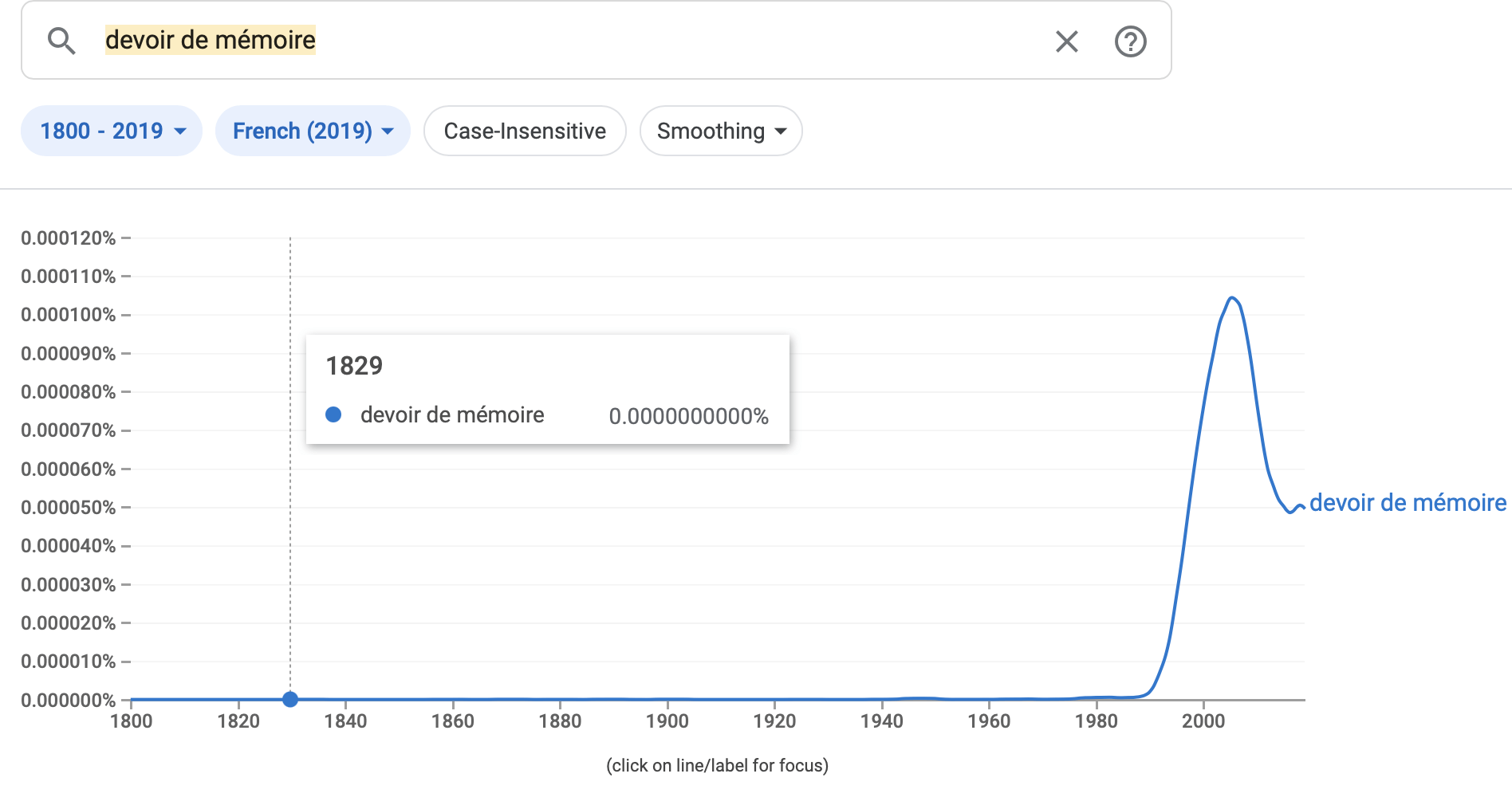
The first use of the expression, according to the records of the Institut National de l’Audiovisuel (INA), which archives French radio and television programs, dates to 1988 (radio) and 1992 (TV). It happened relatively late, in spite of the existence of archival notices that refer to early testimonies of the forties to the seventies as using this expression. These notices may have been written under the influence of another “present,” however, that of the eighties and nineties.
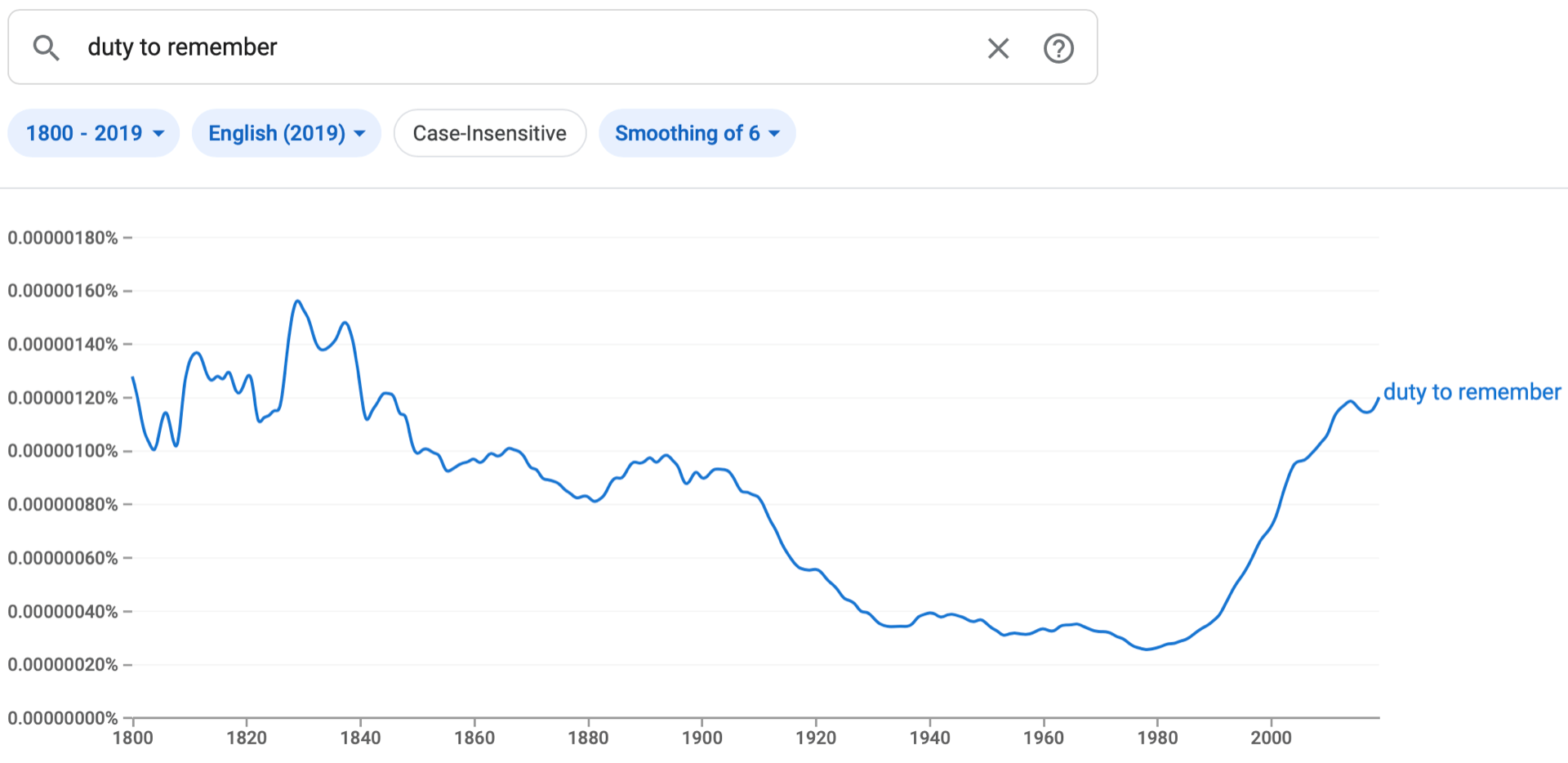
If one looks at different media more widely, one sees that the expression “devoir de mémoire” takes off in the 1990s in French books. The Google Ngram viewer (books) confirms that the y-curb takes off for French from 1990 on. The English equivalent, the “duty to remember” (see the second diagram below), has a more complicated history, it seems, but I won’t go into it here. The ngram curve for “duty to remember” is at its lowest in 1980 and picks up consistently in 1990 and on, in parallel with the curve for “le devoir de mémoire.”
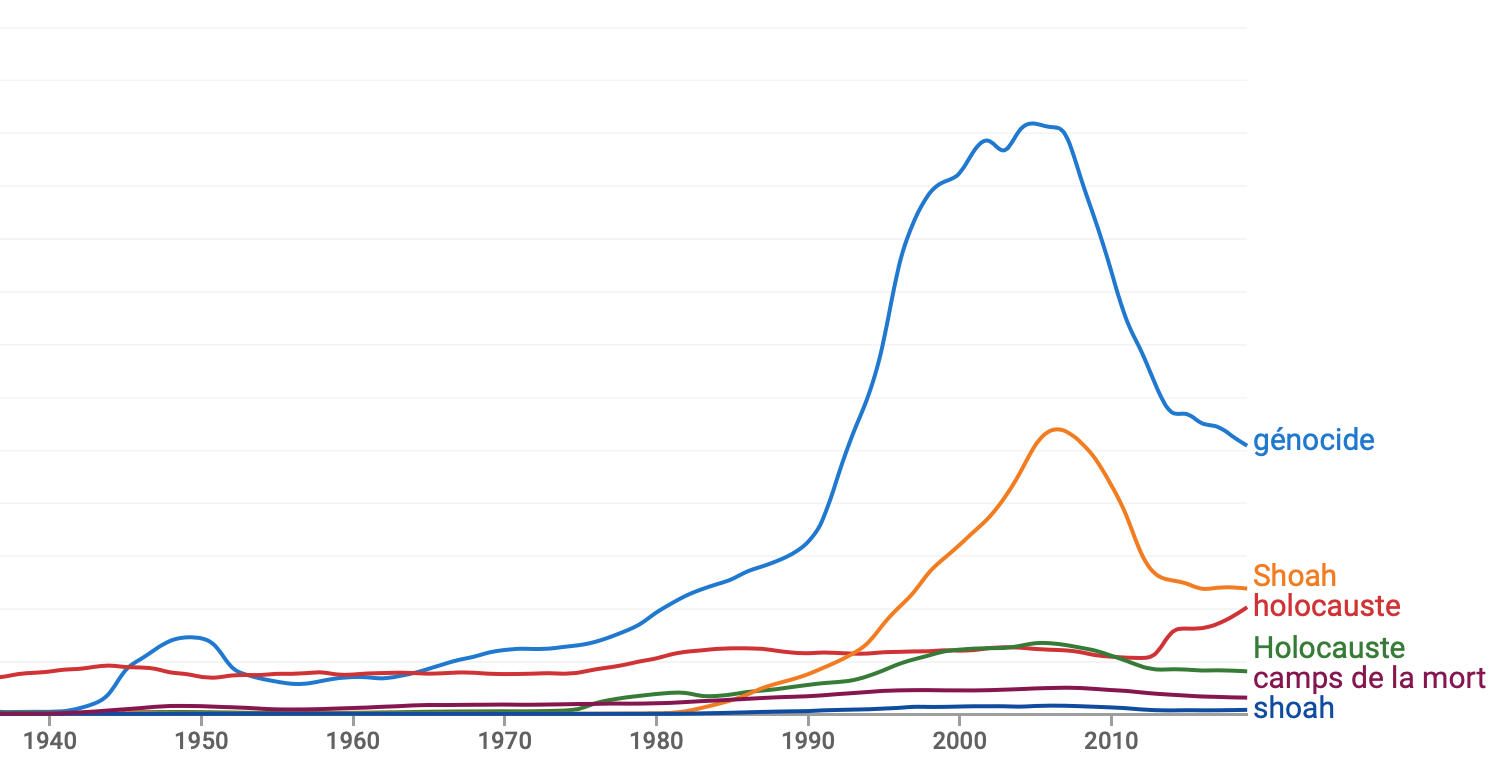
This datable irruption of a devoir de mémoire got me interested in the fate of the word holocauste in French culture. The word has long been used in ancient Greek and Christian (Catholic) liturgy. It meant an offering that was entirely devoted to a divinity and burned, for instance in an animal sacrifice. In its more recent use in French for the murder of Jews in WW II, two main steps seem to have been significant. One phase would be its restricted use for many years—since the fifties—by the author of La nuit, Elie Wiesel, because of its evocation of fire and the story of the ’aqedah, but unfortunately joined to François Mauriac’s Christological interpretation. Wiesel abandoned the use of that word because he felt that it had become used all too superficially. This may have happened in the late seventies, in reaction to the US film mini-series The Holocaust and the ensuing commodification of the word. The second step in the increased use of the word holocauste starts already with Eichmann’s trial in 1961 and continues with the influence of The Holocaust US series (1978), itself a competitor of Roots. The capitalized form—the Holocaust—takes off in the seventies, while the non-capitalized word has always been in usage, most probably because of its liturgical and biblical importance. Its renewed usage in French in the seventies, with a new meaning, corresponds to the massive decline of Christian practice, especially Sunday mass, its readings and prayers. In English, the word “holocaust” evolved much earlier into a metaphor and made a secular meaning possible. Its religious charge became diffuse in the seventeenth and eighteenth century according to the Oxford English Dictionary, and the word could apply to a local fire or catastrophe, often with a considerable number of victims.
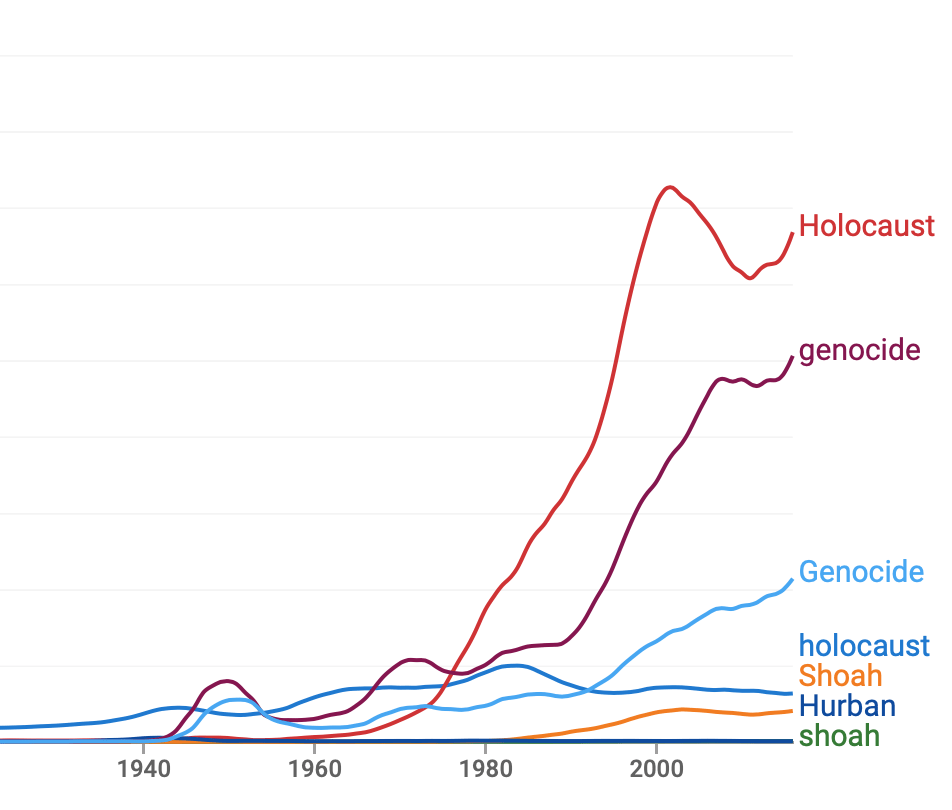
Shoah, in its US spelling (it is also spelled Shoa and Sho’ah), has been spreading in French since the early eighties, especially since Claude Lanzmann’s film of the same title (1985). It competes with French holocauste or English holocaust, but has remained limited in usage. Much more limited yet, at least outside of Jewish religious circles, is Hebrew/Yiddish churban or khurbn eyrope. It has the tangled advantage of situating the event in a long historical chain bound to the destruction of the two temples but is linguistically and theologically baffling for non-Jews and even for many Jews. One wonders what Elie Wiesel, quoted above, made of this element from his mama loshen. Holocauste has seen a decline in French but is as current in English as genocide. See those terms in the Google Ngram viewer for further evidence of these reconstructions of the past with feelings and notions of the present.
Back briefly to the contemporeanousness of multiple presents and pasts that historians are expected to navigate expertly. Or rather back to their porosity. The borders between the assumed present memories are not clear. Neither are those between past(s) and present(s). Something real, however, points beyond “holocaust” and “genocide,” the markers of a live, present, evolving collective memory. The present memorialization is partly created of new cloth (“genocide” is a neologism) and partly made out of the débris of an ancient “memory palace” (“holocaust”). What does it mean for us to remember and reconstruct a past on the basis of a re-imagined present whose social structures seem so difficult to grasp? Or: Doesn’t the call to remember need the support of historical inquiry, and vice-versa? This question is triggered by my reading of Maurice Halbwachs’ Les cadres sociaux de la mémoire (Paris: Colin, 1925), especially the last two chapters on religious and social memory. An English version exists: On Collective Memory (Chicago: 1992).
bloavezh mat 2021
The United States is in better shape than one might think for the short term and maybe even the long term for at least three reasons. One, the astonishing, hard-won victory of the Democrats in Georgia, which is a signal for the ‘centrist’ Republicans—there are perhaps more of them than one thinks or at least several are recasting themselves as such—as well as for the Democratic Party, that it is necessary to go back to political programs—the Republican Party had not even bothered to offer one for the November 2020 elections—and collaborate on certain issues rather than wage an all-out war that started long ago with Newt Gingrich. Two, the election of Biden and the putative composition of his cabinet, which seems very professional, measured, centrist, and experienced. All the capitalist institutions are of necessity behind the new government, given the events. And finally the failure of the insurrection of Wednesday, after which a Ted Cruz or Josh Hawley of the senate, as well as a hundred plus representatives of the chamber, still felt constrained to repeat Trump’s lie and place their bets as his demagogue heirs for 2022 and especially 2024.
I was personally afraid of seeing this demagoguery succeed, because we cannot hide the fact that the labor, health, financial, and economic situation of the states and the country, despite the present possibility of borrowing at very low interest, is causing great misery. Greater difficulties may follow. It would not be surprising to see the Republicans play this old card of capitalist redistribution and quickly rebuild their reputation: less taxes and above all less social programs, no matter the consequences of the pandemic, while stoking anger, radical mistrust, and division to mask their support of economic and social division. Prior to Wednesday’s events, I thought that Trump’s haphazard demagoguery was a logical step in sync with the consequences of vast economic disparities. I thought that it would lead to worse demagogues like Cruz and Hawley, who would be far more calculating, organized, and dangerous than Trump himself. Now I think that these cynical demagogues have erred in judgment by betting on Trump. But the poisonous lie that they glibly repeat regarding the fraudulence of all elections has taken a life of its own and will live on, whether there is a Trump in the background or not. The coming weeks will tell us if the Republican Party will stop to think about its choices and anchor itself in a traditional right rather than marking time and eventually continuing its march towards fascism.
Persian Gulf
In yesterday’s NYT, T. Friedman gave a wrong-headed analysis of the situation in the Persian Gulf and what Biden should try to do now that he is boxed in by the attack in Iran three days ago. His advice is that one should recognize how significantly the Middle-East is changing because the US have become the top world producer—fourth exporter, however, far behind Saudi Arabia—and this has led to a new alliance against Iran by Israel, the UAE, and Saudi Arabia (mezzo voce). This fundamental fact should be recognized in new negotiations. Not a word about Palestine or about the history of the Persian Gulf and Iran, most importantly. According to him, the negotiations should not center on the past nuclear agreement but on a second reality-changing fact, namely that Iran has been manufacturing and using dangerously sophisticated missiles, as shown for instance by an attack in September 2019 on the Abqaiq refinery (by Iran or the Houthis?), and selling them to its proxies (Iraq, Syria, Hezbollah, Hamas, Houthis). Not a word about the continued presence of overpowering US forces in the Persian Gulf. And even less on the sale of US sophisticated weaponry to the UAE, SA, Israel, and others.
war and elections
Very bad news today: the assassination of Iran’s head of nuclear research, Dr. Mohsen Fakhrizadeh, by an armed group of at least five to six people who were clearly very prepared and had complex support. How did they put a pickup truck full of explosives on the road this scientist was supposed to take, have a car full of armed operatives right near, and then manage to disappear?
The most worrying aspect is the date chosen for an attack whose objective appears to be—on the most irenic reading of it—to prevent a return to the Joint Comprehensive Plan of Action signed in 2015. In fact, I don’t think it simply makes the declared task of the president-elect—rejoin or renegotiate the JCPA—much harder or rather impossible. It goes much further, into uncharted territory. The murders of two weeks ago (by Israel?) and the prior assassination of Qasem Soleimani by US forces, make it more likely now that Trump’s electoral goals and the military designs of those who use him (the present government of Israel and Pompeo, I imagine) have become one single end, just when US election laws and courts left no hope to Trumpists. It looks like the circumstances—new right-wing personnel in the Defense Department and reluctance by this outgoing administration to inform Biden’s team—are ripe for war, whether Iran retaliates or not.